Robotics in senior care
More people are living longer while fewer working-age caregivers are available, and new construction sits at multi-year lows. Staffing alone can’t close that gap. Service robotics is one of the few levers that gives caregiver time back to residents without adding headcount.
The demand side is not slowing down:
Occupancy and workforce figures: NIC MAP.
What a service robot actually does
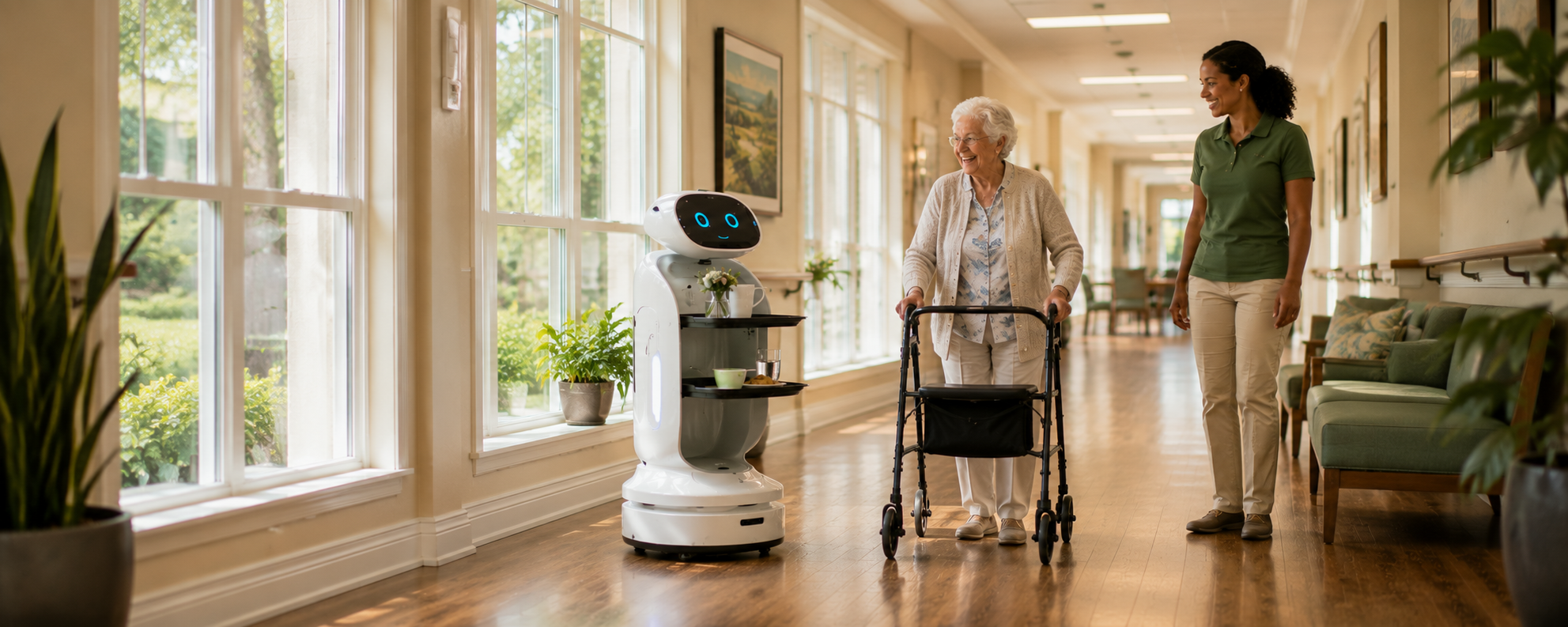
A robot is a workflow tool, not a science project. The right question isn’t “is it impressive?” — it’s “what work can it reliably take off the team?” Every useful robot does five things:
senses the space · moves safely through it · does a real task · reports what happened · fits the workflow you already run
Where it fits in a community
How residents respond
From autonomous floor-care deployments across 75+ communities (Sabra · Direct Supply · SoftBank Robotics): 92% support continued use, 87% say flooring looks cleaner, 82% respond positively to the robot, and 63% noticed the building smelled fresher.
Ninety days from interest to adoption
A steady cadence keeps robotics from becoming a pilot that never scales. Start with required, predictable work that steals time from care.
Measure the burden, name an owner, define success
Routes, Wi-Fi, charging, and telling staff and residents what’s coming
Review weekly, adjust routes and timing
Keep what earns its place; document the return
“Robotics doesn’t replace hospitality. It protects it — by cutting the errands that pull staff away from residents.”
Program data courtesy of Direct Supply, an APN supplier partner. Funding pathways and the full evaluation worksheet are in the member edition.
Evaluate robotics with APN Advisory →